
Fri, Nov 8, 12:05 PM:
New government must invest in truly affordable council homes
Guardian letters 6th November 2019
The consequences for council tenants of a systemic abuse of power called the London housing market are described by Hazel Sheffield (Under the wrecking ball: hundreds of homeless families placed in housing slated for demolition, theguardian.com, 4 November). The homeless families are not “placed”; they are “forced” to move under the wrecking ball by council officials on pain of being declared intentionally homeless, thus losing any right to further assistance from the council.Before 2012 councils were required to offer council housing at council rents to tenants faced by demolition. Since 2012 tenants can be forced by the same threat to take permanent accommodation in the private sector, sometimes tearing them out of their communities, and moving their rent from £90 a week to more than £300 per week for a two-bed home. The low-income citizens of London need public land in order to live in truly affordable permanent homes. Local authorities and the government are recklessly selling that land to the highest bidder. The number of families in temporary accommodation in London has risen 77% to 56,000 since 2010.It will only get higher unless there is a dramatic intervention to buy land and empty property. The banks were saved by quantitative easing. Why not the homeless?
Rev Paul Nicolson
Taxpayers Against Poverty
– – – – – – – – – – – – – – – – – – – – – – – – – – – – – – – – – –
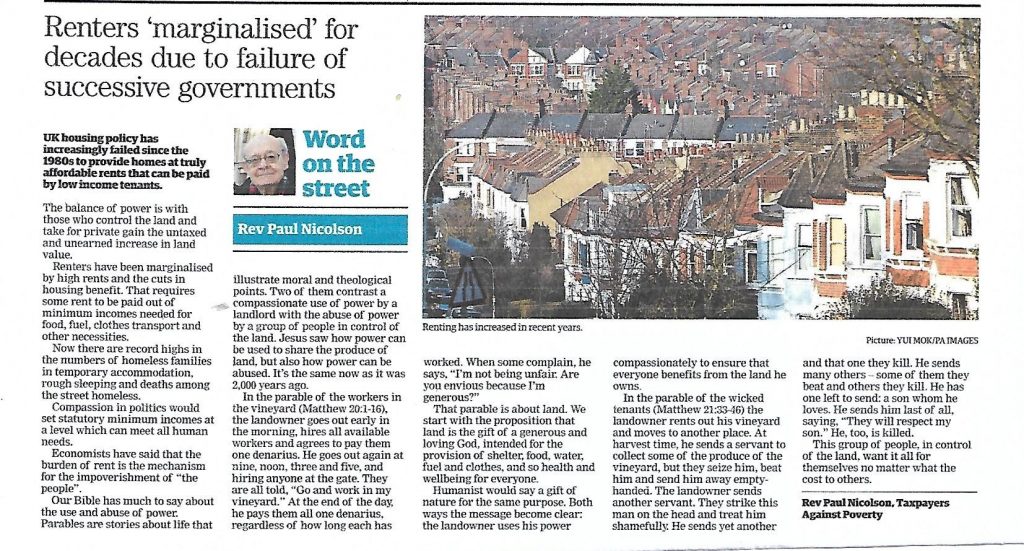
| Ham & High Express 9th November 2019 |
Inequality Street – The Resolution Foundation
Housing and the 2019 general election 9th November 2019
Daniel Tomlinson: This note identifies three reasons why housing has risen up the public and political priority list in recent decades. First, low home ownership, particularly among young adults, has produced significant discontent among younger generations. Second, higher levels of housing costs have pushed down on household living standards. Third, and more recently, while cuts to housing benefit have hit those renting on lower incomes, low interest rates have benefitted higher-income mortgagors, increasing overall inequality in the process. We offer five policy approaches by way of recommendations – in a timely fashion for those writing manifestos – that if implemented, would help address the deep seated issues that lie at the core of the public’s housing concerns.Key findingsThe share of families headed by those aged 25-34 owning their home has fallen by almost half over recent decades, from 50 per cent in 1989 to 28 per cent in 2017.In 1980, the average working-age family spent one-tenth of its income on housing gross of housing benefit; today it spends one-fifth.In 1980, the average working-age family renting privately spent 12 per cent of its income on housing gross of housing benefit; today it spends almost three time this amount at 35 per cent.Housing cost to income ratios gross of housing benefit have increased fastest among those working-age families on the lowest incomes (in the bottom quintile), by 24 percentage points (from 15 to 39 per cent) between 1980 and 2017. This compares to just a 2 percentage point increase (from 7 to 9 per cent) for those on the highest incomes (in the top quintile).Seven-in-ten social renters in receipt of housing benefit had their rent fully covered by the benefit in 2010-12, but that share has fallen in recent years to just over a half in 2015-17.Low-income families have suffered a £1,200 living standards hit from fast rising housing costs since 2002. At the same time, thanks to falling interest rates, high-income families are £400 better off as their housing costs have fallen in real terms since 2002. This means that recent trends in housing costs have acted to push up inequality in the UK.
Living Wage Week: A special episode of Hungry Homeless Powerless pod casts to mark the Living Wage Week 11-17 November 2019. It is no wonder there is poverty in families that are working, when the wages that so many people are paid, are just not enough to live on. To find out why we need a real living wage, I spoke with Katherine Chapman, director of the Living Wage Foundation. I then spoke to Rev Paul Nicolson, who as Chair of the Zacchaeus 2000 Trust initiated the first research into what minimum income standards which then became the basis of the real living wage, he went on to found the campaigning group Taxpayers Against Poverty.
The good health and wellbeing of all UK citizens must now become a national priority
Taxpayers Against Poverty • Partnered with Compassion in Politics
A VOICE FOR THE COMPASSIONATE MAJORITY: No citizen without an affordable home and anadequate income in work or unemployment.
Supported by TAP RESOURCES INDEX on our website www.taxpayersagainstpoverty.org.uk, https://www.compassioninpolitics.com/
TAP DEPENDS ON SUPPORTERS – PLEASE CONSIDER a
MONTHLY CONTRIBUTION – THANKS
